

The language of brand colors

Why the World’s Greatest Brands Understand Human Psychology Better Than Most People Realize
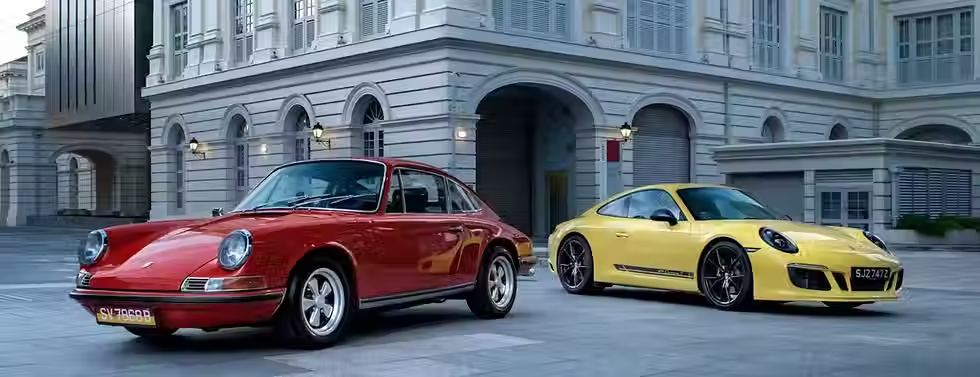
In the modern economy, color is no longer decoration... it is strategy.
The world’s largest brands understand something many consumers rarely stop to consider: human beings do not purchase logically first; they purchase emotionally first and justify rationally afterward. Color, typography, sound, spacing, and symbolism are carefully engineered to create emotional associations that influence trust, urgency, desire, appetite, status, and memory. Research across branding and consumer psychology continues to demonstrate that color significantly shapes consumer perception, emotional response, and purchasing behavior.
When Coca-Cola saturates the market in red, it is not accidental.

Red stimulates excitement, energy, appetite, and urgency. Fast-food chains frequently employ red and yellow because these colors are psychologically associated with stimulation, optimism, speed, and hunger. Financial institutions, by contrast, often use blue because blue conveys security, stability, calmness, and intelligence. Luxury brands frequently lean into black, gold, and minimalist palettes because exclusivity thrives on restraint rather than noise.
The psychology behind this is profound.
The human brain processes visual information far faster than text, and color acts as an immediate emotional signal before conscious thought fully forms. Studies examining color psychology in branding consistently show that color influences attention retention, emotional connection, and even perceived product quality.
What the largest global brands are truly attempting to do is not merely sell products; they are attempting to shape behavioral patterns.
They want consumers to feel something before they think something. Apple seeks to create emotional identification with innovation and sophistication. Starbucks attempts to sell comfort and ritual more than coffee itself. Nike markets identity transformation rather than footwear. The transaction becomes secondary; the emotional world becomes primary.
This is where the distinction between marketing and branding becomes critically important.
Marketing is the act of attracting attention and generating action. Branding is the act of shaping long-term perception and emotional memory.
Marketing says:
“Buy this.”
Branding says:
“Become this.”
Marketing drives immediate conversion. Branding builds cultural meaning. Marketing campaigns may come and go, but branding determines whether a company remains psychologically relevant for decades.
This is precisely why rebranding has become increasingly common in the modern era. Generational shifts continually alter cultural values, aesthetics, communication styles, and emotional expectations. What resonated with Baby Boomers may appear outdated to Gen Z. What felt premium in 1995 may feel artificial in 2026. Studies on generational consumer behavior show that younger audiences increasingly value authenticity, digital fluency, personalization, ethical positioning, and emotional transparency from brands.
Rebranding, therefore, is often an attempt to close the gap between the world a brand created and the world society has now become.

Some companies execute this masterfully.
Others lose themselves entirely.
A subtle brand refresh preserves recognizable identity while adapting to modern expectations.
A full rebrand attempts to reposition a company for a fundamentally different future.
Experts increasingly warn that brands that abandon their core identity too aggressively risk alienating loyal audiences and destroying accumulated brand equity.
The recent public reactions to controversial rebrands, such as Jaguar’s dramatic transformation, demonstrate how emotionally attached consumers become to brand identity. The CEO of the company stepped down after the rebrand failure. A brand is not merely a logo; it becomes a psychological relationship.
So what prevents a brand from collapsing into irrelevance?
The Conclusion
In my view, enduring brands survive because they master three difficult balances simultaneously:
Consistency without stagnation
Innovation without identity loss
Emotional resonance without manipulation
A brand crumbles when it forgets who it is, or when it refuses to evolve at all.
The strongest brands in history are not simply visually attractive. They are emotionally coherent. Every color, every campaign, every experience reinforces the same underlying promise. Consumers may not consciously analyze these systems, but subconsciously they feel them.
And perhaps that is the most fascinating truth in modern branding:
People rarely remember every advertisement they see, but they remember how a brand made them feel.
Color is simply the first whisper in that emotional conversation.


Comments